
Table of Contents
Risk Management Policy
Objective: To embed principles of effective risk management into existing practices at all levels of the organisation.
Scope: This policy applies to all workers of A2Z Services, irrespective of their employment arrangement. This policy covers all people engaged to undertake tasks at A2Z Services workplaces/locations including independent contractors, work experience students, trainees, apprentices, and volunteers.
Policy: Risk is inherent in all A2Z Services functions. All A2Z Services personnel are responsible for managing the risks that relate to their particular area of work.
The following structure for risk management will apply.
- Where specific regulations require certain controls:
- A2Z Services will ensure compliance with those matters, in consultation with relevant persons (including Duty Holders/Contractors);
- Hazard Identification:
- Identify reasonably foreseeable hazards that may pose risks to health and safety;
- Evaluate risks where required:
- Compare estimated levels of risk against pre-established criteria (including a risk matrix) and consider the balance between potential benefits and adverse outcomes;
- Manage risk:
- Elimination of risk being the first option investigated and instigated for a control action;
- Where the risk cannot be eliminated, minimise the risk so far as is reasonably practicable;
- Implement risk controls:
- Secondary to elimination, selection of controls will follow a hierarchy:
- Substitution with less hazardous options;
- Isolate people from the hazards;
- Use of engineering controls;
- Where risk remains:
- Implement administrative controls;
- Where risk remains:
- Use of PPE;
- Use any one or a combination of these controls as appropriate;
- Secondary to elimination, selection of controls will follow a hierarchy:
- All controls must be fit for purpose, suitable for the nature and duration of task and installed set-up, and used correctly;
- Review risk controls whenever:
- Control is no longer effective;
- Before any change likely to introduce new or different hazards that current controls will not adequately address;
- A further hazard or risk is identified;
- Results of consultation indicate a review is needed where requested by workers or Health and Safety Representative.
Risk Management Procedure
This procedure will assist in the early detection of hazards, the assessment of risks and the implementation of control mechanisms in line with the needs of the workplace.
Responsibilities:
At A2Z Services the PCBU is responsible for ensuring that:
- There is an effective Risk Management Procedure and associated mechanisms in place and that they meet WHS and Worker’s Compensation legislative requirements;
- All workers are trained and familiar with, have access to, and participate in risk management policies, procedures and activities while working at A2Z Services;
- Others who are impacted by WHS at A2Z Services, such as additional PCBU, self-employed workers and visitors, are included in risk management strategies as required;
- Conduct a review of the Risk Management Procedure as necessary.
Managers/Supervisors are responsible for:
- Informing workers and others about the requirement to actively participate in risk management strategies and to follow risk management policies and procedures while working at A2Z Services;
- Ensuring adequate training for all people in how to participate in risk management activities in the workplace;
- Maintaining records required by current WHS Legislation relating to risk management.
All workers are responsible for working safely and for following reasonable directions in respect of the WHS Risk Management Procedure and associated mechanisms while working at A2Z Services.
Procedure:
A2Z Services has implemented a step-by-step mechanism to provide the required system and tools to ensure effective risk management in the workplace. They are as follows:
- Communication – the Consultation, Cooperation and Coordination Policy and associated procedure are in place to enable risk management to be implemented systematically and efficiently, involving all people impacted by WHS at A2Z Services. Effective consultation and planning is essential during every phase of the Risk Management Procedure and associated activities;
- Hazards are identified and reported via the following:
- Consultation – WHS Meetings, HSR, briefings, direct discussions etc.;
- Workplace inspections;
- Audits – internal and external (photos, observations, checklists, reports);
- Reporting – Incident Forms (OF0023) , Hazard Report Form (OF0077), etc.;
- Research – gather and interpret information from State and Local Authorities, manufacturers, suppliers, industry groups, other PCBU and workers;
- Risk assessment – conduct workplace-specific, task-specific, chemical and plant risk assessments and environmental impact risk assessments as required by suitably trained and experienced workers;
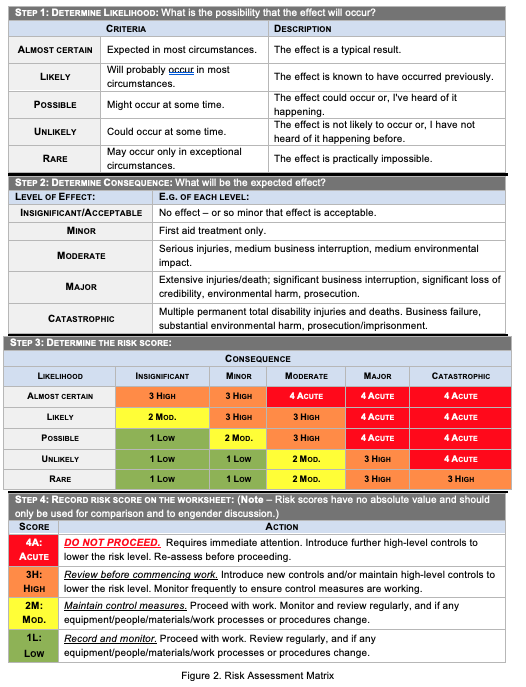
- A Risk Assessment Matrix (figure 2) which accompanies each risk assessment form (OF0005) is used to assist in determining risk levels;
- Actions prioritised – assess risk levels then a list of action priorities is determined;
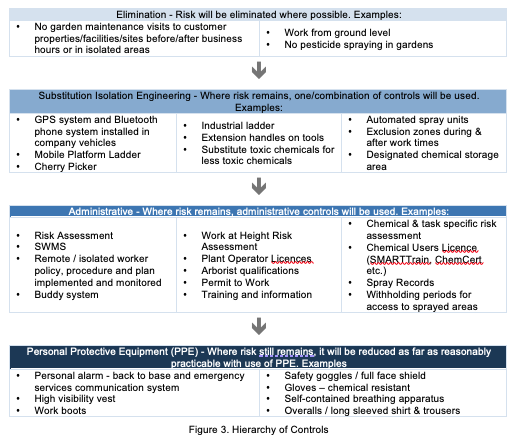
- Risk control – identified hazards are systematically eliminated or reduced by implementing practical control measures. Use the Hierarchy of Controls (Figure 3);
- Monitor and review – regular checks are carried out to ensure the implementation of suitable control measures, that they continue to be adequate, and that no new hazards have been introduced into the workplace either by implemented control actions or by changes to the workplace;
- Documentation – all risk management activities conducted and the outcome of those activities, in particular, those outlined in this procedure, are fully documented and records maintained.
It is essential that workers continue to look for hazards in the workplace at all times, not just during risk management activities. All hazards that cannot be eliminated immediately must be reported to the person responsible using hazard-reporting mechanisms. Consider the potential for the introduction of new hazards in the workplace when planning or changing work tasks, equipment etc. in the workplace.
Environmental risk management, including the potential for chemical spillage, is included in all relevant risk management policies and procedures within A2Z Services.
Where identified hazards and risks are well known and subjected to accepted risk control measures, no further risk assessment will be required, and risk controls can be implemented. These controls, however, will be monitored and reviewed accordingly. For all other identified hazards, a risk assessment must be undertaken to determine how likely to the hazard is to harm people, and how severe the harm could be. The process used to conduct a risk assessment is outlined below in Figure 2 Risk Assessment Matrix.
Work health and safety laws require selecting risk controls following a “Hierarchy of Control”. As far as reasonably practical, risk must be eliminated. Where this is not possible, risk can be reduced using substitution, isolation and engineering controls. For remaining risk, use administrative controls and PPE. Risk controls must be reviewed and monitored to ensure they remain effective.
All controls will be reviewed and monitored:
- When/if incident/near miss occurs;
- As per legislative requirements;
- As requested by relevant persons (such as HSR);
- Other times necessary to ensure effectiveness.
It is essential to consult with relevant workers during the selection of controls and remember that any changes to the task (including introducing new equipment and ways of doing things) can result in further risks. Provide sufficient training, information, instruction and supervision where required.
Risk Assessment and Control
Complete a generic risk assessment (OF0005). Review to ensure they apply to each workplace and develop a workplace-specific work procedure for these tasks. Support the implementation of appropriate controls by the development of procedures, information, training, and adequate supervision. If risk remains, Personal Protective Equipment (PPE) will also be used to reduce risk.
Risk controls will be maintained to ensure they are suitable for the task and that they remain effective for the duration of the job. The Operations Manager will be responsible for monitoring risk controls associated with remote/isolated work.
A2Z Services believes that some tasks may be too hazardous to be undertaken in remote/isolated conditions. These tasks include activities defined as “High-Risk Work”.
A2Z Services will not permit workers to conduct extremely hazardous works without the following strategies in place:
- At least two workers present at workplace (Buddy System);
- Dedicate one worker to observing the task, and no other duties will be assigned;
- Emergency response and rescue procedure;
- Prior communication with local emergency response authority to inform them of the time/location of activities, the risks and potential rescue situations that could occur and expected time for emergency service personnel to arrive when alerted.
Complete a Remote and Isolated Work Plan for every activity that requires work in remote/isolation. The plan must be agreed between supervisors and workers and signed off by General Manager Complete the ‘Call-in Log’ section throughout the task.
A2Z Services will maintain all equipment (such as transport vehicles, power tools, powered mobile plant, earthmoving machinery etc.) as per legislative requirements. Complete the Plant and Equipment Register/Maintenance Log for all equipment assigned for and used during remote/isolated work.
A2Z Services will ensure workers are provided with safety and emergency equipment. Including: Personal Location Beacon (PLB), communication equipment (to be kept on person, not in the vehicle), GPS locating devices, vehicle break-down kit (high visibility gear, wet weather gear, reflective/high visibility cones, spare tyre, toolkits), emergency contact information. First aid kits, fire protection equipment, and any other items required for specific tasks. Emergency Contact information must be relevant to the specific workplace and can be printed and laminated as necessary
Forms and Registers
| Document Number | Document Name |
| OF0035 | Job Safety Analysis (JSA) |
| OF0005 | Risk Assessment Form |
| OR0017 | Risk Register |
| OF0023 | Incident and Near Miss Form |
| OF0077 | Hazard Report Form |
Amendment Record
Issue#: 1 Issue Date: 13/7/2022
| Rev# | Date | Section# | Para.# | Description of Change | Prepared By | Approved By |
| 1 | ||||||
| 2 | ||||||
| 3 |
Disclaimer: This documentcontains material to assist in meeting environmental management, Work Health and Safety and Quality obligations under the International Standard ISO AS/NZS ISO 9001:2016,14001:2016 and other legislative bodies. This document contains material sourced from Safe Work Australia. Any such material remains subject to copyright © Commonwealth of Australia. https://www.safeworkaustralia.gov.au/copyright. Although every effort has been made to ensure the accuracy of this information at the time of publication, it is provided as guidance only and does not provide legal advice on meeting your obligations. This document and its contents are © A2Z services 2018 and or the originating source authors and no permission is given for its duplication or copying, in part or in its entirety, for use outside its original purposes as stated within the company.