
Table of Contents
Issue Resolution Policy
Objective: The objective of this policy is to ensure that all WHS issues arising in the workplace are resolved in an efficient, timely and suitable manner to enable maintenance of a safe and healthy work environment at A2Z Services.
Policy: This policy will provide guidelines for a consultative, systematic and fair approach to resolving work health, safety or welfare issues that may arise. A2Z Services will adhere to the guidelines and requirements of the current WHS Legislation and follow a process of natural justice to resolve any WHS issues raised in the workplace.
In attempting to resolve any WHS issue, A2Z Services will have regard to relevant matters, including, but not limited to:
- The degree and immediacy of the risk to workers or other people affected by the WHS issue;
- The number and location of workers and other people affected by the WHS issue;
- Corrective measures (temporary and permanent) that must be implemented to resolve the issue, using appropriate mechanisms to eliminate and control risks;
- Who will be responsible for implementing the resolution measures;
- Consultation between all parties involved and affected by the WHS issue.
Workers will not be penalised, in any way, due to a safety issue being raised and actioned at A2Z Services.
Issue Resolution Procedure
This procedure will provide a practical framework to enable the resolution of any WHS issue that may arise at A2Z Services.
- Responsibilities:
At A2Z Services the PCBU is responsible for ensuring that:
- There is an effective Issue Resolution Procedure and associated mechanisms in place that meet legislative requirements;
- All A2Z Services workers, when required, are trained and familiar with, have access to and participate in the Issue Resolution Procedure and related devices;
- Conduct a review of the Issue Resolution Procedure as required.
Managers/Supervisors are responsible for:
- Informing workers and others about the requirement to participate, and follow, the Issue Resolution Procedure and associated mechanisms while working at A2Z Services;
- Ensuring adequate training for all relevant workers on how to track and action the Issue Resolution Procedure in the workplace;
- Conducting, and enabling, issue resolution when required with all workers and workgroups;
- Maintaining records required by legislation relating to issue resolution.
The HSR/WHS Manager is responsible for:
- Maintaining and reviewing the Issue Resolution Procedure as required;
- Ensuring all workers have access to adequate issue resolution information and mechanisms and that they actively participate in issue resolution when needed in the workplace;
- Informing and consulting with the PCBU/CEO regarding issue resolution as necessary;
- Maintaining formal, approved issue resolution mechanisms and records required by legislation;
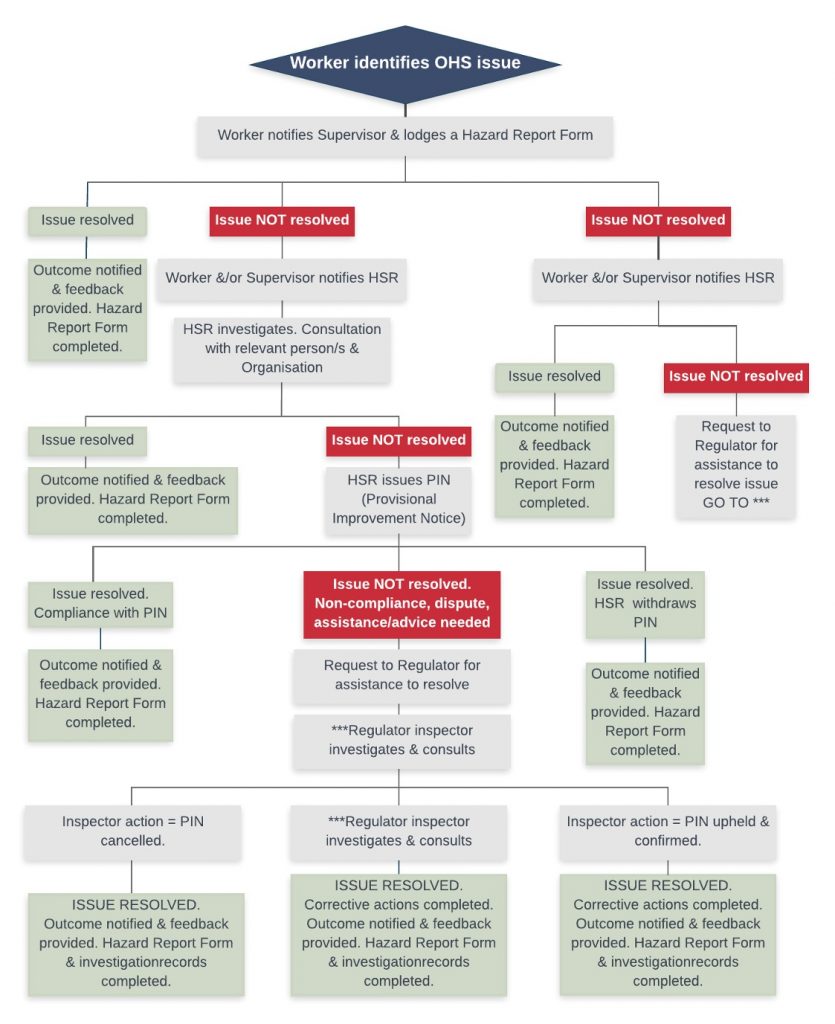
- Seeking assistance from the regulator when needed, as per the Issue Resolution Procedure Flow Chart and the requirements of current legislation.
All workers are responsible for actively participating in and following reasonable directions in respect of issue resolution while working at A2Z Services when required.
Informal Issue Resolution Procedure: A workers who wishes to raise a WHS hazard/concern should first discuss the issue directly with their supervisor or manager. The supervisor/manager will:
- Consider and investigate the matter, including contacting other relevant workers at A2Z Services who may be able to assist in resolving the WHS issue;
- If possible, implement or arrange to implement, actions to address the hazard/issue, as soon as possible;
- Consult with and inform the worker who raised the issue of the outcome of the investigation, and all corrective actions;
- Ensure to complete and retain a Hazard Report Form as a record of the issue, the result and resolution;
- Monitor and review the issue at an appropriate and agreed time to ensure there is no repeat of the issue.
If the WHS issue is resolved satisfactorily at this stage, then there is no need for further action.
If the WHS issue is NOT resolved, at this stage, the problem will progress to the Formal Issue Resolution Procedure. Refer to Figure 1. Issue Resolution Procedure – Flow Chart.
In the event of a severe immediate risk to workers: In the situation when a definite and direct safety hazard is perceived, and the issue is considered critical and urgent, the worker or HSR will inform the relevant supervisor, who will call an immediate halt to work to investigate the matter.
If the supervisor/manager fails to agree about the degree of risk present or the supervisor is not available, an HSR or a worker from that workgroup will direct affected workers (and any others who may be affected) to withdraw from the alleged hazard. They will then inform the appropriate manager and the PCBU of the actions taken pending a full investigation.
Work will not resume until the hazard has been controlled and no longer presents an unacceptable risk to the safety and health of workers and others.
Issue Resolution Procedure Flow Chart
Forms and Registers
| Document Number | Document Name |
| OF0077 | Hazard Report Form |
Amendment Record
Issue#: 1 Issue Date: 13/7/2022
| Rev# | Date | Section# | Para.# | Description of Change | Prepared By | Approved By |
| 1 | ||||||
| 2 | ||||||
| 3 |
Disclaimer: This documentcontains material to assist in meeting environmental management, Work Health and Safety and Quality obligations under the International Standard ISO AS/NZS ISO 9001:2016,14001:2016 and other legislative bodies. This document contains material sourced from Safe Work Australia. Any such material remains subject to copyright © Commonwealth of Australia. https://www.safeworkaustralia.gov.au/copyright. Although every effort has been made to ensure the accuracy of this information at the time of publication, it is provided as guidance only and does not provide legal advice on meeting your obligations. This document and its contents are © A2Z services 2018 and or the originating source authors and no permission is given for its duplication or copying, in part or in its entirety, for use outside its original purposes as stated within the company.