
Table of Contents
Non-conformity and Corrective Actions
Identification of Non-conformances:
It is the responsibility of all employees to bring suspected non-conformances to the attention of General Manager. Non-conformances may be identified through the following methods:
- Audit findings (internal or external)
- Observation
- Incidents / Near-misses
- Complaints (internal or external)
Control of Non-conformances:
When non-conformity occurs with one of our products or services, including where a customer is not satisfied with what they have received, we will do all possible to:
- React to the nonconformity by way of acknowledging that we have not met the customer’s requirements (a form for recording the nonconformity can be found at Non-conformance Form (OF0007) and we will, as applicable:
- Take the appropriate actions to control the process and correct the issue; and
- Do all possible to fix the relationship with the customer and provide assurance that the nonconformity does not occur again.
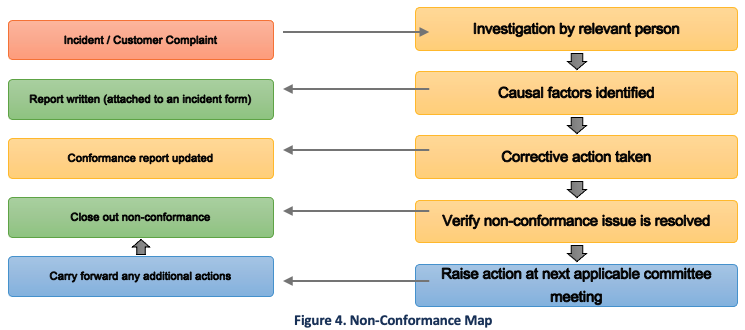
- Investigate and evaluate where the nonconformity occurred and develop actions to eliminate and / or mitigate the causes of the nonconformity so that reoccurrence should not happen again. We will do this by:
- Reviewing and analysing the nonconformity for the causes of the failure;
- Determining if similar nonconformities exist in our processes or if they could potentially occur;
- Attach the Non-Conformance Form (OF0007) to detail the nature and scale of the non-conformance. This should include proposals for corrective and preventive actions, as appropriate;
- Implement the actions needed to ensure that the nonconformity does not occur against within our processes;
- Review, monitor and measure the effectiveness of the new corrective actions;
- Use the analysis in the planning cycle and update our known risks and opportunities;
- Update the QMS as required.
The corrective action taken will be of appropriate magnitude to the effects of the nonconformities encountered. The corrective actions are risk assessed to ensure that the benefits of the change are forthcoming (Corrective / Preventative Actions Form) (OR0004).
Any nonconformity will be kept as a record to provide evidence of:
- What the nonconformity was;
- What the subsequent actions that were taken to fix the nonconformity; and
- The results of monitoring and measurement on the corrective actions.
Repeated non-conformances of a similar nature are to be reported to Directors for action and resolution.
Preventative Action Policy
Purpose:
The purpose of this policy is to define the process for identifying, documenting, and implementing preventive actions to reduce and/or eliminate failures in service delivery. Potential non-conformances will be examined, and actions taken to prevent their occurrence.
Requirements:
All employees are required to:
- Follow this procedure on detection of a possible non-conformance;
- Bring it to the attention of their supervisor / manager immediately.
Management is required to:
- Implement actions to address the potential nonconformity;
- Setup processes to monitor and review any actions taken.
Preventative Action
It is the responsibility of all employees to bring potential non-conformances (things that may occur) to the attention of General Manager. Potential Non-conformances may be identified through the following methods:
- Audit findings (internal or external);
- Complaints (internal or external);
- Observation;
- Incidents / Near-misses.
Potential Non-Conformances Control
When a potential nonconformity or other threat is identified, we will:
- Take the appropriate actions to control the process before a non-conformance occurs;
- Investigate and evaluate how and where the nonconformity may occur and develop actions to eliminate and / or mitigate the potential of the nonconformity to arise.
We will do this by:
- Reviewing and analysing the potential nonconformity for causes;
- Determining if similar nonconformities exist in our processes or if they could potentially occur;
- Attach the applicable Non-conformance Form (OF0007) to detail the nature and scale of the potential non-conformance. This will include proposals for corrective and preventive actions, as appropriate;
- Implement the actions needed to ensure that the nonconformity does not occur within our processes;
- Review, monitor and measure the effectiveness of the corrective actions;
- Use the analysis in the planning cycle and update our known risks and opportunities;
- Update the QMS as required.
The corrective action taken will be of appropriate magnitude to the effects of the nonconformities encountered. The corrective actions are risk assessed to ensure that the benefits of the change are forthcoming (Corrective / Preventative Actions Form) (OR0004).
Any potential nonconformity will be kept as a record to provide evidence of:
- What the potential nonconformity was;
- What the subsequent actions that were taken to fix the potential nonconformity; and
- The results of monitoring and measurement on the corrective actions.
Repeated reports of a similar nature are to be reported to Directors for action and resolution.
Forms and Registers
| Document Number | Document Name |
| OF0007 | Non-Conformance Form |
| OR0004 | Corrective and Preventative actions Form |
Amendment Record
Issue#: 1 Issue Date: 13/7/2022
| Rev# | Date | Section# | Para.# | Description of Change | Prepared By | Approved By |
| 1 | ||||||
| 2 | ||||||
| 3 |
Click here to download OM00020 – Non-Conformance and Preventative Actions Policy in PDF Format
Disclaimer: This documentcontains material to assist in meeting environmental management, Work Health and Safety and Quality obligations under the International Standard ISO AS/NZS ISO 9001:2016,14001:2016 and other legislative bodies. This document contains material sourced from Safe Work Australia. Any such material remains subject to copyright © Commonwealth of Australia. https://www.safeworkaustralia.gov.au/copyright. Although every effort has been made to ensure the accuracy of this information at the time of publication, it is provided as guidance only and does not provide legal advice on meeting your obligations. This document and its contents are © A2Z services 2018 and or the originating source authors and no permission is given for its duplication or copying, in part or in its entirety, for use outside its original purposes as stated within the company.