
Table of Contents
Introduction
A2Z Services is dedicated to providing all workers with a workplace that is, as far as is reasonable, safe and without risks to health and safety. This Drivers’ Safety Manual has been developed to provide guidance and information for drivers to prevent injury or illness.
All workers also must cooperate with the measures to eliminate or reduce risks. Each driver has access to this manual at all times. These procedures and rules are to be strictly followed by all drivers.
This Drivers Safety Manual always remains the property of A2Z Services.
Copyright applies to this Drivers Safety Manual, which contains sensitive company information. Do not allow this manual to be given to people outside of the organisation.
Policy
A2Z Services will maintain a fleet of vehicles to support its operational activities. Vehicles may only be used for work purposes and be driven by authorised persons. A2Z Services recognises motor vehicles are high value assets, essential for the effective provision of services and must be maintained and used responsibly.
We also recognise that operation of any vehicle or plant can be inherently dangerous and as such should be only operated safely, within the road rules, within company policy guidelines, appropriately and sensibly.
Scope
This policy applies to all employees and authorised persons who drive and/or have an A2Z Services’ vehicle under their control or supervision and should be read in conjunction with the Motor Vehicles – Procedure. Employer vehicles are fitted with a GPS tracking device for the purposes of security and monitoring driver behaviour.
Employer vehicles may only be used for authorised business unless previous arrangements for home garaging or personal use have been agreed in advance. Vehicles may not be used for the carriage of passengers for hire or reward, nor may they be used for any type of motor sport, including racing, rallying or ‘pacemaking’, whether on a public road or private land.
A2Z Services will endeavour to prevent injury and eliminate hazards associated with vehicles and mobile plant by ensuring:
- Safe work procedures are in place
- Safety equipment is available for use (e.g. ramps, blocks etc.)
- Provide adequate training, information, instruction and supervision.
Review Procedure
The Managing Directors will review the Drivers Safety Manual as required. The review schedule will be directed in response to organisational and/or legislative changes and requirements. The reviews will be undertaken in consultation with workers, health and safety representatives and other relevant parties. All relevant persons will be made aware of changes made as a result of the review.
This Drivers Safety Manual will be reviewed if:
- it is identified that there are changes in the workplace that may affect procedures;
- it is identified that the procedures are not effective;
- there are legislative changes that affect the procedures;
- there is a serious incident or dangerous occurrence.
All procedures will be reviewed at least annually.
Management Commitment and Approval
This Drivers Safety Manual has been approved and endorsed by Senior Management of the Organisation. The signature of the authorised person, in the footer, Director/General Manager demonstrates a commitment to the CoR Management Plan.
| Signature: | Date: 22/12/21 |
Working with Vehicles and Mobile Plant Procedures
Responsibilities:
At A2Z Services takes responsibility for ensuring that workers are aware of, trained in, and understand the hazards associated with working with vehicles and mobile plant.
The PCBU is responsible for ensuring there are safe systems in place when working with vehicles/mobile plant.
Managers/Supervisors are responsible for ensuring that:
Workers are responsible for ensuring:
Procedure:
Uncontrolled movement of vehicles and mobile plant:
To prevent uncontrolled movement always ensure:
DO NOT rely on portable hydraulic system to hold any part of equipment in raised position Always use installed lift brace equipment and/or suitable SWL blocks/jacks.
Driving licence and Authority to Drive Employer Vehicles
It is paramount that you possess the appropriate, current driving licence that allows you to drive the class of vehicle you are in control of in the areas you will be driving in. You must also have management’s authority to drive during the performance of your duties. Such authority is registered.
You must be able to produce your current driving licence for scrutiny by management at any time as requested. This will be done during initial training, at regular intervals, and when the information thereon is required. It is the driver’s responsibility to inform management of any changes to the licence.
While driving on Employer business, as a minimum you must always observe and obey the relevant road laws in the state or territory in which you are driving. In addition, A2Z Services have several policies in place to protect you your passenger’s safety and the safety of others as well as the longevity of our plant and equipment. Any breach of the road rules or our policy statements may result in disciplinary action.
If at any time you are disqualified or any infringements incurred from driving, management must be informed immediately. It is your responsibility to see that any Employer vehicle is not used by anyone other than authorised employees. If you are driving a motor vehicle especially with Employer branding on display, you are representing the company at any time while driving or in public. You must therefore drive in a manner that is considerate of other road users. Any complaint about a driver will be investigated and disciplinary action may result.
Vehicle GPS Trackers
Introduction
It is a condition of your employment with A2Z Services that you are aware that we can and do track your movements through tracking of our applications, phones, iPad, vehicles and other equipment. We do this primarily for safety. Many staff work independently, and we just want to know that you are safe, at work and whether you have been delayed or available to re-deploy on another task. It is also becoming more prevalent in our industry that it is a condition of employments. For example, a client complains that they won’t pay an invoice because the job wasn’t done. It becomes simple for us to bring up a log that will tell us that you were there from … to, thus ending the query.
What tracking information do we want and why
- Infrastructure is a significant impost on the business. Our staff have iPads and phones to the value of $2000, vehicles worth much more and various other items of significant value. We don’t want to lose them, and we don’t want them misused or you to place yourselves or others at risk.
- While you are at work, we want to know where you are, for your safety, for our oversight of you as an employee, to satisfy and manage service contracts and purely so that we can deploy our major resource, you, as appropriately as possible.
What don’t we want to track
We do not wish to track your movements outside work hours, but it does happen.
What about your information and privacy
We are bound by privacy law. We already protect a large body of knowledge about our staff and our clients and their security systems and take this responsibility seriously. The log information will only be used for the above internal company related purposes. As per the signature below, we undertake not to divulge this information to any third party except where we are instructed to do so by a relevant legal authority.
In future, clients may well, for security and other reasons, insist on access your information. This will not be done retrospectively or without your permission and with the option of 14 days’ notice.
Summary
You should be aware as a condition of employment we need to be able to log our staff at work and our equipment. This is for your safety and the safety of our equipment. All equipment being logged or used to log your position should display a clear company warning prominently. If it does not contact management as soon as possible to rectify this.
We insist that you have the right to not have your movements logged for 14 days after signing this policy, but, because of the nature of our equipment, we may not be able to use you till the end of that 14 days if you do not waive that right voluntarily allowing us to start immediately.
If you have any questions about this policy, please – Contact your supervisor
I am confident that I have had all my questions answered and have read and understood this entire document.
I agree to waiving my rights to delaying the logging my position by A2Z Services. I am aware that not waiving this right could mean a delay in my undertaking work for the company.
As a manager of A2Z Services, I undertake to not divulge this person’s personal information, including his position log, without their permission unless legally required to.
Management and Maintenance
It is the responsibility of each driver to ensure company vehicles are kept clean.
Staff are responsible for ensuring the company vehicle is filled with fuel. Staff are to use the correct fuel card for the vehicle, are to record the registration number on the fuel receipt and provide to the Finance Manager at the earliest opportunity. Presently this is done by uploading the receipt to your digital receipt bank. A suitable description should be appended to each such upload.
Regular maintenance and servicing of vehicles is overseen by the Operations Supervisor in collaboration with the Area Manager. Staff are responsible for ensuring the oil, water and tyre pressure levels are checked on a weekly, as well as lapses in service schedules and registration are notified.
Vehicle and trailer servicing to be completed by a qualified mechanic
Any maintenance or repair work, or replacement of parts, including tyres, must be approved in advance by the Employer, and reimbursement will only be made against production of an authorisation. When requested by the Employer you must ensure servicing is carried out. Full details of the work required, and the cost involved must be given.
Before you use one of the Employer’s vehicles, and on its return, you are responsible for ensuring that the oil and water levels, battery and brake fluid and tyre pressures are maintained and that the tread of all tyres conforms to the minimum legal requirements. All vehicles must be refuelled upon return.
Any damage to vehicles or any mechanical issues are to be reported to the Operations supervisor when acquired or noticed. Punctured tyres must be taken for immediate repair by the driver once the Operations Team Leader has been notified. This expense will be covered by A2Z Services.
Fixtures, Fittings and Modifications
No fixtures such as aerials, roof racks, towing apparatus, or stickers may be attached to any Employer vehicles without prior written permission.
No change or alterations may be made to the manufacturer’s mechanical or structural specification of the vehicle are permitted without consent and an engineer’s approval.
Security of Vehicles (garaging and safety)
All vehicles are garaged in the yard behind the gates of the Company’s premises. The gate is to be kept always locked outside normal business hours.
Company vehicles may be used for organisational business during working hours and must be returned to their garaged location at the end of every shift.
Where vehicles are being home garaged, they are to be kept in a secure location, fully locked. Approval to home garage a vehicle does not approve personal use of a vehicle. Personal use of a vehicle needs to be approved by an appropriate authority in addition to approval for home garaging. Using an A2Z Services vehicle for personal use without approval may result in disciplinary action, up to and including termination of employment.
Housekeeping
A daily vehicle pre-start is to be completed by technician
A weekly condition and cleanliness report is to be completed by technician and signed off by Area Manager or Operations Supervisor
Vehicle and Travel Safety
It is an offence under NT legislation to possess or consume alcohol within prescribed communities. Any employee found to be in possession of or consuming alcohol in a remote community will be the subject of disciplinary action, up to and including termination of employment. Similar action will be taken if a driver is found to be in any way impaired by alcohol or drugs.
Driver Fatigue
To prevent driver fatigue, employees are to adhere to the NT Road Traffic Authority’s Stop, Revive, Survive process, including:
Theft
In the event of the theft of a company vehicle, staff members are required to contact the police in the first instance. The Operations Team Leader should be notified as soon as possible, A police report must be made, and the incident number recorded and supplied to the Operations Team Leader. If any contents are stolen from the vehicle, the police and the Employer should be notified immediately.
Please note that only Employer property is insured by the Employer, and you should make your own arrangements to cover your personal effects.
You must always lock the vehicle, apply the handbrake (and vehicle blocks if appropriate) and secure its contents, and turn on any alarm system that is fitted to the vehicle. The contents should be stored out of sight, preferably in the boot or rear. If a vehicle is stolen, we are required to prove to the insurance company that there has been no negligence and, therefore, we must hold you responsible in the event of such negligence.
Infringements
Parking and other traffic infringements are the responsibility of the driver at the time they were incurred. Staff are required to provide sufficient details to allow traffic infringement notices to be redirected to the driver by way of statutory declaration.
Staff are responsible for all fines and repair costs due to voided insurance while driving an A2Z Services vehicle without a relevant driver’s license which is valid in the area being travelled.
Any staff member found driving over the legal alcohol limit or under the influence of drugs will be responsible for payment of all fines and repair costs due to voided insurance in the case of an accident, and it will result in disciplinary action.
Entering/Exiting the Vehicle
Before approaching the vehicle to enter it, check for traffic before opening the door. Use available steps and grab handles if required and for trucks etc. maintain 3 points of contact during the climb into the cabin.
When exiting and before opening the door, check for traffic including cyclists – never jump to the ground—exit, facing the vehicle, using the steps and grab handles in a controlled movement. Maintain 3 points of contact during exit.
Access Ladders and falling objects
- Inspect vehicle ladders during the pre-start inspection;
- Ensure footwear is suitable. Snug-fitting shoes/boots with flat, non-slip soles, no loose soles, long laces, soles that are oily, or caked with mud or other contaminants;
- Use safety harness as required;
- Wear an appropriate tool belt to carry tools (e.g., livestock prodder) when ascending or descending the ladder;
- NEVER ASCEND OR DESCEND A LADDER CARRYING ANY EQUIPMENT;
- Face ladder when ascending/descending or working from it;
- Ensure 3 points of contact remain on the ladder at all times (one hand and two feet or two feet and one hand);
- Ensure only 1 person working from each ladder.
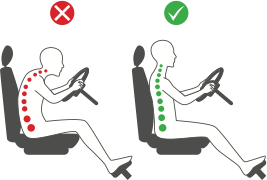
Vehicle Ergonomic Principles
- Steering Wheel:
- objects and controls to be in easy reach to prevent unnecessary reaching;
- elbows and shoulders relaxed with hands positioned below shoulder level;
- Headrest:
- position centrally behind the head;
- Mirrors:
- the rearview and side mirrors to ensure the adequate vision of surrounding areas;
- Seat Height:
- raise to provide maximum road vision;
- ensure adequate clearance from the roof;
- Lower Limb Position:
- knees bent comfortably to operate foot pedals;
- the steering wheel should not touch the top of legs;
- Seat Plan:
- thighs supported along the length of cushion;
- avoid pressure behind knees;
- Back Rest:
- shoulders slightly behind hips;
- Lumbar Support:
- an S-shape spine is a safe shape.
Seatbelts
The value of seat belts in saving lives has been demonstrated by many studies, showing decreases in truck driver fatalities by 40% to 50% when a seat belt is worn. Wearing of seatbelts while driving is a condition of employment. When driving, all drivers and passengers MUST wear a seatbelt where seatbelts are fitted.
Speed Limits
The speed limit is exactly that. It’s a limit, not an essential speed you must do. Drive at a speed that is safe for the conditions. Slow down for work zones, wet, icy or gravel roads and other situations where it will take longer for the vehicle to stop. If you cannot see at least 5 seconds ahead, slow down.
Never drive over the speed limit under any circumstances. Always follow road rules, signs, recommended speed signs (for curves in road etc.), and do not enter areas where trucks are prohibited.
Maintain a crash avoidance space around the vehicle. Take into account reaction times and response time. An alert, fit driver (not fatigued, not under the influence of drugs/alcohol) will require approx—1.5 seconds to react. On top of this, the general response time required is 2-3 seconds. This means that you should keep a distance or crash avoidance space of at least 4 seconds – and this will increase in low visibility – poor weather conditions or at night.
Use the following separation distances if following another vehicle (adapted from the Land Transport (Road User) Rule 2004):
- 2 Vehicle Lengths, if speed is 40 km an hour or more but less than 50 km an hour; or
- 3 Vehicle Lengths, if speed is 50 km an hour or more but less than 60 km an hour; or
- 4 Vehicle Lengths, if speed is 60 km an hour or more but less than 80 km an hour; or
- 5 Vehicle Lengths, if speed is 80 km an hour or more
In addition, A2Z Services states that speed is not to exceed 80 km/hour on unsealed roads. Trucks are always restricted to 100 km/hour on all sealed roads. When driving a trailer max speed limit on sealed roads is 100km/hour and 80km/hr on unsealed roads. The most important part to remember is to always drive to the conditions
Failure to adhere to these speed limits or any limits applicable to the driver’s licence may result in disciplinary action, up to and including termination of employment. In addition, vehicles should be always driven safely and responsibly.
Road Rage
Road rage can be a cause of workplace violence. Travelling to and from work or travelling on the road exposes you to the chance of a violent encounter with other drivers:
- do not be the cause of a road rage incident;
- do not cause other drivers to become aggressive towards you because of poor road manners;
- do not drive erratically. Allow enough time to get to your destination;
- take into account delays related to weather or heavy traffic;
- never write or talk on your mobile phone while driving;
- obey all speed limits and traffic signs;
- maintain an awareness of vehicles around you and avoid aggressive drivers;
- be courteous to other road users;
- never make rude gestures, honk horn inappropriately or flash your lights unnecessarily.
Sometimes we are confronted by threatening behaviour (road rage) through no fault of our own. If you are threatened:
- try to drive away, taking a different route to take yourself away from the incident if necessary;
- if followed, do not stop, particularly at your home or workplace. Continue to drive to the nearest police station or until the person stops following;
- if a police station is not nearby, then a public place with lots of people may be the next best thing;
- always stay inside the vehicle at all times. Never exit the vehicle to confront another driver;
- if you are approached while in the vehicle, ensure windows remain up, and doors are locked. Remove seat belt and move to the other side of the vehicle. (this way you may be able to escape from the opposite side door of the vehicle if necessary);
- if you feel in fear of actual harm call police immediately.
Vehicle Accident or Breakdown
In the case of breakdown, loss of load, or accident:
- safely stop and secure the vehicle ensuring parking brake is set (try to park as far out of traffic as possible);
- activate the emergency hazard warning signal flashers;
- safely place warning triangles as soon as possible:
- place the first triangle between 50-150m from the front of the vehicle or fallen load;
- place second triangle 50-150m from the rear of the vehicle or fallen load;
- place the third triangle at the side of the vehicle to allow sufficient warning to other road users.
The driver may leave the vehicle and call for assistance only after the vehicle has been secured and warning devices put in place. When calling for assistance, the driver must provide the exact location of the vehicle and the following information:
- road or highway route number;
- nearest mile marker or exit;
- the direction of travel;
- nearest city or town;
- current location of the driver if different from the vehicle;
- contact phone number where the driver can be reached;
- be as specific as possible and provide a suggested diagnosis of the cause of the breakdown.
Once the accident/breakdown has been reported, the driver’s call will be forwarded toyour Area Manager. If a road service call is necessary, the driver or Area Manager will locate and contact an authorised repairer to facilitate repairs.
Once repairs have been made, the driver must notify Area Manager turn on the emergency hazard warning flashers, and safely remove the warning triangles.
All paperwork for the repairs/accident will be forwarded to Area Manager where it will remain on file.
Vehicle Accident
Should you be involved in an accident, the important thing is to remain calm and undertake the following:
- Immediately after an accident stop and ascertain whether any person has been injured and render all practicable assistance to any injured persons;
- Stay calm and be as helpful as possible;
- Avoid admitting fault or liability;
- If you are carrying a placarded load (hazardous substances), ensure all persons are removed from the immediate area and inform emergency services immediately on triple zero (000). Describe the contents on the load to the emergency service operator.
Call 000 if there is an emergency or if any of the following criteria are met:
- death or injury (requiring medical attention from a qualified ambulance officer, nurse or doctor);
- the suspected involvement of drugs and/or alcohol;
- a driver fails, has failed or is refusing to provide required details;
- a hazardous environment or threat to public safety exists, including traffic congestion (e.g. fuel spill, power lines down);
- a driver with an impairment or disability requires police assistance.
In a minor accident, if possible, move the vehicles so as not to cause a hazard to other road users:
- secure the vehicle ensuring parking brake is set;
- switch off the ignition of the immobilised vehicle to reduce the risk of fire.
Ask for (this must be given by law) the driver or riders:
- full name and address;
- the name and address of the owner of the vehicle; and
- if the vehicle concerned is a motor vehicle, the registration number on the plates assigned to the vehicle.
Give to the other the driver (on their request), the same details.
If the accident involves an injury or death, report the accident to the police as soon as possible, (not later than 24 hours).
You must always provide police attending the crash scene with details of the crash:
- vehicles involved;
- your name, address;
- if known, information about any witnesses or the drivers of other vehicles involved;
- you must always show police your driver licence.
Regardless of damage, if you are asked to, you must provide the owner or driver of any other vehicle involved in the crash with the following information:
- your name, address and licence details;
- your vehicle registration number;
- if you are not the owner of the vehicle, the name and address of the owner.
Note: You can ask the other driver/s for similar information.
If the accident involves damage to an unoccupied vehicle or to other property you must, as soon as practicable, and not more than 48 hours (2 days) after the accident, report to the owner your:
- name and address;
- number of the vehicles involved in the accident;
- the location of the accident.
If the accident involves damage to an unoccupied vehicle or to other property, but the owner cannot be contacted or identified, the accident must be reported to police as soon as practicable and not more 60 hours (2.5 days) after the accident. You must advise management by phone before any vehicle recovery action being taken.
Tyre Changing
- Park vehicle in a safe location:
- do not stop vehicle unless safe to do so (Vehicle can travel a short distance with a flat tire- ensure low speed is kept until the vehicle is clear of traffic);
- the vehicle stopped in a safe- level position. Consider environmental factors:
- park out of the line of traffic (ensure far enough from the road to be safe);
- consider sun in oncoming driver eyes;
- the vehicle is not positioned on crest or bend of the road;
- make allowance for low visibility (night-time, fog, rain);
- park out of the line of traffic (ensure far enough from the road to be safe);
- turn vehicle hazard lights on;
- put reflective hi-vis safety vest on before commencing operations;
- remove the keys from the ignition and place them in your pocket;
- place traffic warning triangles/ flares in a suitable location to warn oncoming drivers (Use caution on the roadside).
- Prepare vehicle for tyre change;
- ensure park brake is on;
- Oopposite side wheels are chocked to prevent vehicle moving;
- check appropriate jacking point on vehicle is accessible. Area cleared of obstructions loose material etc. (check vehicle manual for jacking locations);
- remove spare tyre, vehicle jack and wheel brace (check condition of all items);
- ensure spare wheel and tools are ready but are kept well away from any road verge.
- Commence tyre changing operation;
Handy Tip: Place a vehicle floor mat upside down on the ground where you will be kneeling;
- using the wheel brace or rattle gun, loosen the wheel nuts but do not remove them. Place the jack under the approved jacking location (see vehicle operating manual) If the ground is soft use base plate;
- raise the vehicle until the flat tyre is approximately150mm off the ground (remember, the replacement tyre will need more room to fit because it will be fully inflated;
- unscrew the wheel nuts completely and remove. Ensure they are placed in a safe position. Do not simply place them on the ground where they may be lost;
- remove the flat tyre by pulling towards you (wear gloves in case the tyre has been damaged and wire strands are sticking out);
- retrieve spare tyre and place in front of wheel hub (ensure valve stem faces outward to ensure the wheel is the correct way around);
- align the spare tyre with the wheel bolts. Lift and push into place;
- replace with the new wheel. Use levers (or a breaker bar) to lift the wheel over and onto the studs;
- replace the wheel nuts by placing one nut at the top of the rim, another at the bottom of the rim to prevent the wheel falling off. Then replace nuts in any sequence;
- use rattle gun or wheel brace to run nuts up tight against the rim in a cross pattern. Use levers to settle the rim against the wheel nuts and re-tighten in a cross pattern;
- use wheel brace to tighten until just firm, however, ensure that not enough force is applied to upset the stability of the jack (the nuts will be tightened fully after lowering vehicle);
- lower vehicle and remove jack;
- tighten wheel nuts as much as possible using wheel brace—tension each wheel to the required torque setting.
- Pack up:
- pick up all tools and equipment and place in vehicle;
- check the area for any items that may have fallen from the vehicle;
- remove traffic safety devices when safe to do so and return to the vehicle.
- On completion:
- remember to turn hazard lights off before departing area;
- travel to the nearest service station to check spare tyre has correct air pressure;
- have the flat tyre repaired as soon as practicable.
Coupling and De-Coupling Trailers
- Coupling pre-check:
- ensure the ground surface is clear of hazards and can take the weight of the combination (i.e. check for soft ground, mud etc.);
- ensure the area is clear of pedestrians or other vehicle traffic (use warning markers, e.g. witches hats or other if necessary);
- wear hi-vis vest when outside of the cab and wear appropriate PPE;
- ensure the turntable is compatible;
- pull the handle to make sure the jaws are open;
- check turntable and components for damage (if damaged seek further advice before coupling);
- check the trailer parking brake is applied;
- check prime mover and trailer for any hazards or faults.
- Coupling procedure:
- slowly reverse the vehicle in a straight line towards the front of the trailer.
- apply the vehicle parking brake, turn off the engine and remove the keys;
- make any necessary adjustments to the trailer coupling height and slowly reverse the vehicle in low reverse to trailer until coupler to lined up;
- apply the vehicle parking brake, stop the engine and remove the keys;
- carry out a visual check that the coupling have engaged correctly and fit any required safety devices and/or locking tabs;
- check the coupling have engaged correctly, and trailer is secure by selecting a low forward gear and with the trailer brakes still applied slowly try to drive forward
- apply the vehicle parking brake, turn off the engine and remove the keys;
- connect all electrical connections and double-check that the coupling have locked on.
- raise the landing gear fully and secure the handle. (check for sufficient clearance between the landing gear and rear of the vehicle to allow for turning);
- remove and stow wheel chock if used;
- check trailer lights work, and reset airbag levels if appropriate to the vehicle;
- release the trailer handbrake and move forward at a low speed;
- conduct final check by slowly applying pressure to the trailer brake to ensure supplied pressure to the trailer brakes is at the correct operating level.
- De-coupling:
- ensure the combination is parked on a firm, level surface wherever possible;
- park the combination in a straight line;
- apply the vehicle parking brake, stop the engine and remove the keys;
- apply the trailer parking brake and chock wheels if required;
- wear hi-vis vest when outside of the cab and wear appropriate PPE;
- lower both landing legs and electrical connections from the trailer
- remove safety clips/locking pins and pull the release handle to disengage the couplings;
- slowly draw the vehicle away from the trailer.
- confirm the trailer is unattached, apply the vehicle parking brake, stop the engine and remove the keys;
- before leaving the trailer, walk around it to check that it is in a safe condition.
Electronic Devices
A2Z Services discourages the use of electronic devices while driving, and we actively promote the concept of “Hands-on wheel, eyes on the road”. If you absolutely must use a device, e.g. a mobile phone or GPS pull over and park in a safe area. Don’t stop where you could be a hazard to other vehicles, pedestrians, or yourself.
Mobile Phones and Tablets
In emergencies use your phone to call for help: Dial ‘000’ in case of fire, traffic accident, road hazard or medical emergency. 000 is a free call and will connect you to emergency services.
When using portable, hands-free devices make sure it is set up and working before you start to drive.
Always keep your eyes on the road and do not read or send SMS text messages or take notes during a call while driving. If required, use directory assistance or a Satellite Guidance System (Sat. Nav.) don’t look up phone numbers from your phone’s memory.
Don’t accept or make calls (including using a 2-way radio) if traffic, weather or road conditions would make it unsafe to do so. Even if the traffic conditions are light, always tell the person you are speaking to that you’re driving and that you may have to end the call if driving conditions change.
If a call becomes complex or emotional, tell the person you are speaking to, you are driving and terminate the call.
If a call is unnecessary or you consider it unsafe to answer at the time, don’t answer the call and let it divert to voicemail or an answering service.
If you choose to stop to answer or make a call or retrieve a message, pull over carefully in a safe area.
Playing loud music with earbuds or headphones in place blocks out traffic noise and Emergency Services sirens. Impeding emergency vehicles is an offence and can lead to fines and loss of demerit points.
Do not attempt to play videos or DVDs while driving.
Always stay fully focused on driving and limit distractions as much as possible.
Fuelling
When purchasing fuel, the guidelines to be followed at all times are:
- a Company Fuel Card is dedicated to each vehicle and is to remain in that vehicle;
- fuel can be purchased from any Puma Fuel Depot or Service Station;
- if no puma outlet is available contact your area manager to determine best outlet to use
- only fuel products or oil is to be purchased on the Fuel Card;
- do not eat, drink or smoke when refuelling and/or when at refuelling point;
- control all ignition sources during refuelling. Examples are:
- vehicle engine;
- electronic devices, mobile phones, pagers etc.;
- smoking;
- lighters, matches;
- static electricity;
- wash hands well after refuelling and before eating or drinking;
- follow relevant safe work instructions and vehicle manufacturer’s instructions for refuelling.
When refuelling away from a commercial outlet, ensure fuel lines are grounded, e.g. static discharge line or earth straps.
Smoking
Smoking is a recognised hazard to health. Based on risk assessment principles, smoking is not permitted in the workplace at any time. It is against the law to smoke in the workplace. Your vehicle is your workplace, and smoking in it anytime is prohibited. Respect all smoking regulations at customers’ premises and especially during refuelling.
Passengers
A2Z Services prohibits the carriage of passengers in company vehicles unless you are authorised by your Area Manager or directors/General Manager to do so. Such authorisation will include the name/s of passengers and the period of authorisation. In emergency situations, e.g. breakdown of another vehicle in remote areas, drivers may be authorised to use their best judgement of the circumstances. If possible, notify your base on the 2-way radio.
Animals
Collisions involving domestic animals, e.g. cattle, horses etc. can cause significant injury to the driver and severely damage the vehicle. Call for emergency services if required, and help the animal if it is safe to do so, remember large animals can cause you serious injury. Try to locate the owner if possible.
Incidents involving smaller domestic animals, e.g. dogs, cats etc. can be quite traumatic for people that witness them. Stop and render assistance, where possible remembering injured animals can inflict painful injuries, and pet owners can be very emotional.
In the case of wildlife or feral animals stop, and if it’s safe, check on the welfare of the animal. If it’s already deceased, try to move the carcass from the road so that it does not become a traffic hazard. If the animal is still alive, and depending on the circumstances, you may have to euthanise it yourself. If you are unable to do this call the SPCA and/or the police.
Keep a written record of details of all such incidents. If the driver sustains any injuries, bites, scratches etc. from contact with animals, it’s important to check with a doctor regarding tetanus injections. Do not handle animals that may expose you to diseases that affect humans (Zoonoses). If not sure, check first with SPCA or Emergency Services.
Uncontrolled movement of vehicles and mobile plant:
To prevent uncontrolled movement always ensure:
- Risk assessment is undertaken prior to working on vehicle
- Keys are removed from the vehicle’s ignition and secured
- Parking brake is on.
- Wheels are chocked on both sides of the vehicle using serviceable purpose-built chocks.
- Work is undertaken on a flat even surface capable to bear the point load of any jacks/lifting equipment or ramps
- A lockout system or warning sign is in place to prevent the vehicle from being started, or the vehicle or any part of it being inadvertently moved.
- Mobile plant attachments are fully lowered before starting work
- For work under heavy vehicles, ensure appropriate load support is used (e.g. stands or lifting devices).
- Do not rely on portable hydraulic system to hold any part of equipment in raised position Always use installed lift brace equipment and/or suitable SWL blocks/jacks.
Unsealed roads Safe Operating procedure
Contact Procedures
- An immediate supervisor or manager is aware of travel itineraries, current locations & what tasks are being undertaken in the remote area(s)
- Scheduled contact persons and Injury reporting procedures are developed and in place
- Mobile & satellite phones and Emergency Position Indicating Radio Beacon (EPIRB) is fit for purpose, tested before departure & phones have spare, fully charged batteries and facilities for continuing charging
- Emergency response procedure is developed & followed by the works depot or office if staff in remote areas fails to make scheduled contact at the nominated time.
- Ensure travel plan is followed and if changing route advise your contact person
- Check in on departure of location with a expected arrival time, once arrive ensure you check in as if no check in is completed search protocol will be implemented
- Use mobile phone or satellite phone for check in procedure
- Keep communication equipment within easy reach at all times in case of emergeny
Vehicle Use
- The speed limit on unsealed roads is 100km/hr for utes and small vehicles and 80km/hr for trucks
- Wear seat belts at all times when driving
- Use mirrors often to monitor the activity around you
- Drive Smoothly – Be aware of the high centre of gravity of 4wd vehicles, start and stop smoothly and avoid sharp turns
- Monitor vehicle constantly for any malfunctions that may affect vehicle performance
- Watch for vehicles entering from side roads/tracks. Give way to approaching trucks/road trains – slow down and move onto the shoulder where safe to do so
- Monitor/use UHF radio, generally channel 40 (Road channel), to monitor for changes to road conditions and vehicle movements
- Drive to the road conditions, i.e. slow down when raining or on gravel roads.
- Avoid road shoulders
- DO NOT drive under the influence of drugs or alcohol
- DO NOT adjust radio channels or volume while driving
- DO NOT use electronic devices while driving:
- If you must use a device, e.g., mobile phone or GPS, pull over and park in a safe area. Don’t stop where you could be a hazard to other vehicles, pedestrians, or yourself.
Unrestrained Objects
- Inspect all equipment and accessories within the vehicle to ensure they have been attached or secured in a safe manner
- Use cargo barriers/nets to separate loads from passengers
- Secure loose items within the passenger area so they do not become projectiles
- Never place small unsecured items under the driver’s seat (they may move forward and interfere with pedals)
- Secure external loads, rear tray, roof racks using appropriate securing equipment
- Properly fitted cargo nets or covers on external loads
- Use caution undoing straps or other restrain equipment after driving – Load may have shifted.
Stock and Native Animals
- Observe speed limits and reduce speed, particularly when kangaroos, stock etc. are observed or expected in the conditions
- Do not swerve or brake suddenly to avoid animals that run out from the verge – brake only as firmly as road conditions allow to maintain control of the vehicle
- Use high beam/spotlight at night in-country conditions (do not use when following another vehicle or within 200metres of an approaching vehicle).
- Avoid driving at dusk and after dark whenever possible to limit possibility of animal strikes
Bushfires
- Carry plenty of drinking water
- Never drive through heavy smoke
- Headlights on to remain visible to other vehicles
- If trapped by fire:
- If possible, park in a cleared area free of vegetation and protected by a structure, e.g. bridge, large rocks etc.
- Avoid the tops of hills
- Remain in the vehicle (leave vehicle running and lights on)
- Tightly close windows and doors and vents
- Lie low on the floor of the vehicle and cover up with any available materials such as floor mats or clothing
- If time allows:
- Clear loose vegetation leaves etc. from under and around the vehicle
- Remove any flammable equipment, e.g. extra fuel or gas bottles
- Wait for the fire to pass before exiting the vehicle.
Crossing Watercourses
- If fording river or stream is necessary, ensure:
- Never drive into the water without checking depth and surface condition
- Do not exceed the vehicle manufacturer’s fording depth
- Stop vehicle – Always check the depth and force of water at creek crossings and see if any obstructions might damage the vehicle
- Attach snatch straps to recovery points before entering the water if the vehicle bogs down (roll-up excess strap and tie off to vehicle in an appropriate location). This way, the vehicle can be towed forward or backward as appropriate without having to fit straps underwater
- Put your vehicle in a low gear
- Proceed slowly but steadily
- Keep the engine revs up
- Stay in the centre of the crossing where the surface is likely to be hardest
- Select a speed that will maintain a bow wave and effectively reduce water depth around the vehicle. (Consider a bonnet shroud where necessary)
- Do not let the engine’s fan come into contact with the water
- Keep your feet off the clutch and brake
- Assess the need to enter the water and if not fundamental for your safety take an alternative route wherever possible
- After exiting the water, check the clutch and brakes for operation before continuing.
Crocodiles
- If travelling in northern regions, use caution and keep a watch for crocodiles
- Never enter the water on foot, e.g., to check depth (if you are not sure of depth, do not cross)
- Do not attempt to swim across waterways
- After crossing, do not stop and exit the vehicle within 6 metres of the water’s edge.
Driving in Sand
- Partially deflate the vehicle’s tyres not less than 5 psi. Deflating tyres increases the footprint of the tyre: When tyres are deflated:
- Avoid sharp turns
- Do not exceed 50 kph
- Re-inflate (if possible) when conditions passed
- Drive at a constant speed – limit gear changes
- Drive-in existing tyre tracks if available
- Drive in a straight line & avoid turning front wheels wherever possible
- Do not use excessive wheel spin if the vehicle becomes bogged – Start recovery immediately to avoid becoming bogged deeper.
Vehicle Recovery Operations
Recovery equipment for 4×4 off-road use with chains, shackles and belts
- Using a snatch strap:
- If practicable, dig in front of all 4 wheels to give the vehicle a chance to pop up
- Ensure snatch strap is rated for use for weights of vehicles to be pulled
- The snatch strap is in good condition with no sign of damage. (Do not use if any signs of damage or tears)
- Attach snatch strap to designated rated recovery points only
- All shackles are rated (stamped with Working Load limit)
- Do not attach to areas such as suspension, steering components, bumper bars, tow balls etc.
- Use snatch strap as per instructions and training, following instructions for connection and safety straps
- All persons are clear of area (at least 1.5 times the length of the un-stretched snatch strap and out of the direct line of sight of the operation (if the strap breaks, attachments, shackles etc. can become lethal missiles)
- Drape a heavy bag or another dampening device (e.g. floor mat) over the strap before the operation
- If using more than one strap feed one end of snatch strap 1 through the eye of snatch strap 2. Then, feed the same eye of snatch strap 1 over the other end of snatch strap 2 and pull it together
- Jack and pack under the vehicle:
- If practicable, dig in front of all 4 wheels to give the vehicle a chance to pop up
- If soil conditions permit, jack up the vehicle and put some form of hard material under the wheels, such as branches, stones, leaves, grass or twigs
- Never place any part of your body under the vehicle while on jacks.
- Using a winch:
- Setup and operate only as per manufacturer’s instructions
- Attach to designated rated recovery points only
- All persons not driving vehicles are clear of area (at least 1.5 times the length of the un-stretched snatch strap and out of the direct line of sight of the operation (if the cable breaks, attachments, shackles etc. can become lethal missiles)
- Drape a heavy bag or another dampening device (e.g. floor mat) over the winch cable before the operation
- If practicable, dig in front of all 4 wheels to give the vehicle a chance to pop up
- Where a winch cable is passed through a snatch block’s pulley and secured to a fixed point, “winch pull” is doubled. Ensure SWL is not exceeded, e.g. shackles, tree trunk protectors, snatch blocks
- If the winched cable becomes caught, release tension to a point where the cable is loose:
- Pry free as required, re-apply tension, and resume winching
- Maintain constant visual contact with cable and/or spotters. Ensure communication/directions followed
- After winch recovery:
- When spooling in, do not let cable slip through your hands. Use hand-over-hand technique and wear leather, snug-fitting gloves
- Inspect condition of rope/cable during spooling to identify any defects
- Do not position hands or body parts close to drum during spooling-in (pinch points exist between cable and drum housing)
- Keep cable spooled tightly and evenly onto the drum, avoid tangling.
Summary
Your safety and that of the public are of primary importance, followed by the longevity of our plant and equipment. Maintaining our fleet at peek mechanical condition, available, clean, and ready for use by the next driver is fundamental to this objective. Your assistance in promoting this objective through adherence and promotion of these protocols is fundamental to your future with the company.
Drivers’ Agreement
I _______________________ (Driver’s name) have read and agree to abide by the policies and procedures in the A2Z Services OHS Drivers Manual. I have raised any questions or issues that required clarification with the organisation, and I am aware that breaches of these company policies will be subject to disciplinary action.
| Drivers’ Signature: | Date: |
| Witness Name: | |
| Witness Signature: | Date: |
Forms and Registers
| Document Number | Document Name |
| OF0036 | Daily Vehicle Pre-Start |
| OF0037 | Weekly Motor Vehicle Check |
| OF0038 | Asset Maintenance Log |
| OR0035 | Vehicle Register |
| OF0005 | Risk Assessment |
| OR0017 | Risk Register |
Amendment Record
Issue#: 1 Issue Date: 13/7/2022
| Rev# | Date | Section# | Para.# | Description of Change | Prepared By | Approved By |
| 1 | ||||||
| 2 | ||||||
| 3 |
Click here to download OM00049 – Motor Vehicle Usage manual in PDF Format
Disclaimer: This documentcontains material to assist in meeting environmental management, Work Health and Safety and Quality obligations under the International Standard ISO AS/NZS ISO 9001:2016,14001:2016 and other legislative bodies. This document contains material sourced from Safe Work Australia. Any such material remains subject to copyright © Commonwealth of Australia. https://www.safeworkaustralia.gov.au/copyright. Although every effort has been made to ensure the accuracy of this information at the time of publication, it is provided as guidance only and does not provide legal advice on meeting your obligations. This document and its contents are © A2Z services 2018 and or the originating source authors and no permission is given for its duplication or copying, in part or in its entirety, for use outside its original purposes as stated within the company.