
Table of Contents
Change Management Policy
Purpose:
The purpose of this policy and procedure is to define the methods for managing changes to processes and other aspects of the management systems in an organised manner.
Policy:
A2Z Services OPS processes and procedures will undergo change over time. Management of changes will occur proactively and reactively as circumstance dictates.
Proactive Change will take place as a result of the following:
- System improvement opportunities are identified and acted upon;
- Non-conformities are identified and, corrective action taken; – Non-conformance Form (OF0007)
- New processes are added;
- Processes are removed;
- Any other proactive response deemed necessary by management.
Reactive changes will take place as a result of the following:
- Industry conditions changing enough to require modification;
- Client requirements change resulting in adjustment;
- Accidents or emergency response;
- Any other reactive response that requires a change or modification of management process.
In both reactive and proactive cases, A2Z Services seeks to manage change in a controlled manner to ensure proper implementation of the changes.
Roles and Responsibilities
The Change Manager is responsible for managing the change process including:
- Implementation, maintenance and communication of policy and procedures around change management;
- Chairing necessary change management meetings;
- Identifying who should participate in the initial risk / impact assessment of the change;
- Provide guidance when necessary.
Change Advisory Board
- Senior management representatives who undertake appropriate risk and impact analysis of the proposed change;
- Responsible for approval, implementation and monitoring of the change;
- Participating in post implementation reviews of the change.
Change implementers:
Responsible for;
- Ensuring change is authorised;
- Planning the change within the required timeframes;
- Obtaining the appropriate resource for the task;
- Successful implementation of the change;
- Attending change review meetings as required;
- Ensuring communication of the change is made known to employees, business owners and customers;
- Participation in the post change review process.
Change Management Procedure
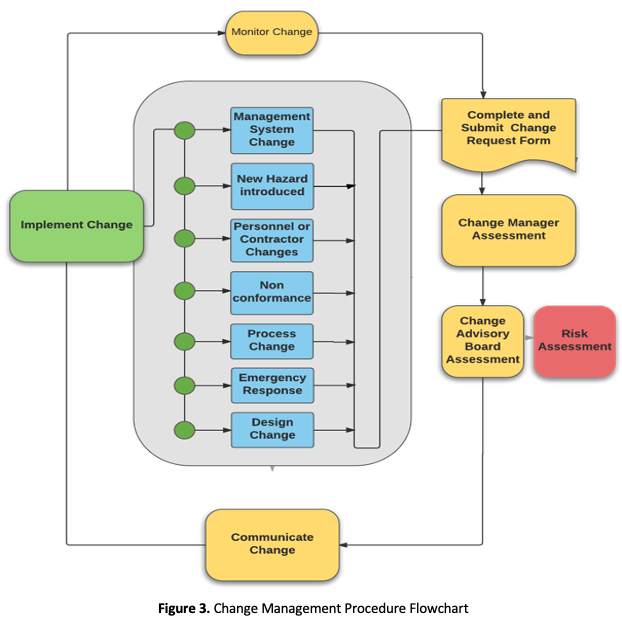
All change management processes will follow the general steps listed below. Each step within this general process may then be further detailed as necessary. Any change to this procedure (as per all documented procedures), will also be required to follow this procedure.
Step 1. Upon considering a change (proactive or reactive) – The request for a process/procedure change must be assessed by the the General Manager (or person acting in that role) to determine the nature of the change. I.e. emergency, ‘minor and not required’ or ‘further action required’. The change request will be documented in a Change Request Form (OF0006)
Step 2. If further action is required, the change request will be recorded in the Corrective / Preventative Actions Form (OF0004) and put forward to the appropriate management representatives for review.
[Note: In the case of an emergency the issue at hand must be dealt with as a priority. The documented change management process will come into effect as a result of changes due to the emergency, not as a process to follow during an emergency]
Step 3. The Change Advisory Board will review the change request.
| Department / Unit | Senior Representative-Title | Name |
| Management | Director | Person acting in this position |
| Overall Office Function | General Manager/Area Managers | Person acting in this position |
| Overall Operations Function | General Manager/Area Managers | Person acting in this position |
Senior representatives will either:
- Reject the change, document the response in the appropriate Corrective / Preventative Actions Form (OF0004) and file the response as a record;
- Assess the change proposal using a risk management approach to arrive at a priority for implementation. (Use Risk Assessment Form (OF0005)
| Priority | Description |
| High | Must be implemented as soon as possible usually immediately with progress reports daily |
| Medium | Must be implemented in 1-3 months or before next process cycle |
| Low | Will be implemented within 12 months or other measure |
- Approve the change and sign off on the approval prior to implementation of the change.
Step 4. The Change Implementer/s will communicate the proposed change to relevant employees, business owners and customers and update the Corrective & Preventative Action Form (OF0004)
Step 5. The Change Implementer/s will undertake the task to affect the change within the designated time frames.
Step 6.
- A Post Implementation review will be undertaken to assess whether that the change was successful or requires modification;
- If successful, the appropriate corrective action form is updated and closed and the Corrective & Preventative Action Form (OF0004) is updated;
- If unsuccessful, the Change Advisory Board will reassess.
Forms and Registers
| Document Number | Document Name |
| OF0004 | Corrective/Preventative actions Form |
| OF0005 | Rick Assessment Form |
| OF0006 | Change Request form |
| OF0007 | Non-Conformance Form |
Amendment Record
Issue#: 1 Issue Date: 13/3/2022
| Rev# | Date | Section# | Para.# | Description of Change | Prepared By | Approved By |
| 1 | ||||||
| 2 | ||||||
| 3 |
Disclaimer: This documentcontains material to assist in meeting environmental management, Work Health and Safety and Quality obligations under the International Standard ISO AS/NZS ISO 9001:2016,14001:2016 and other legislative bodies. This document contains material sourced from Safe Work Australia. Any such material remains subject to copyright © Commonwealth of Australia. https://www.safeworkaustralia.gov.au/copyright. Although every effort has been made to ensure the accuracy of this information at the time of publication, it is provided as guidance only and does not provide legal advice on meeting your obligations. This document and its contents are © A2Z services 2018 and or the originating source authors and no permission is given for its duplication or copying, in part or in its entirety, for use outside its original purposes as stated within the company.